
Building a Home in Campbell River: A Step-by-Step Guide to Buying a Serviced Lot
What ‘serviced’ really includes, how Campbell River permits work, and the steps that keep a build on schedule.
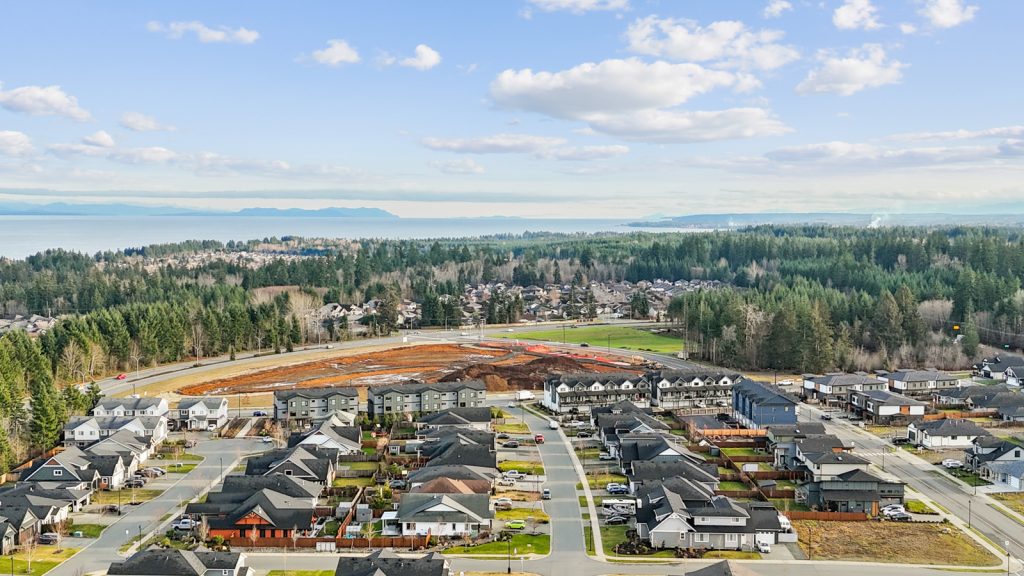
Building a home in Campbell River on a serviced lot is one of the most predictable paths to a new home in BC – if you understand what ‘serviced’ actually means, how the City of Campbell River’s permit process works, and where builds most commonly run off schedule. This guide walks through every stage from accepted offer to occupancy, with specific detail on Jubilee Heights lots where it applies.
What ‘Serviced’ Actually Means – and the Three Things Buyers Forget to Verify
A fully serviced lot brings water, sanitary sewer, stormwater drainage, electricity, and telecom conduit to the lot line. At Jubilee Heights, roads are built to City of Campbell River municipal standards with curbs, gutters, and street lighting already in place. When you take possession of a lot, the infrastructure is done. You are not waiting on a utility to trench to your property.
That sounds straightforward. Where buyers get caught out is in three specific details that do not appear in the listing:
- Connection locations and depths – water, sewer, and storm connections are at specific points on your lot boundary. Your builder needs to know where they are before siting the house, because the foundation drainage and driveway grade depend on it.
- Hook-up fees and deposits – the lot price does not include utility connection fees. In Campbell River, water and sewer connection fees are set by the City and paid separately, typically at permit stage. Budget for these explicitly.
- Driveway and boulevard standards – the City has specific requirements for crossing materials, grades, and boulevard treatments. These affect your driveway design and need to be confirmed before you finalize the site plan.
Jubilee Heights lots at Phase 5 and Phase 6 on Jubilee Parkway have all utility connections mapped and available. Our sales team can provide the servicing summary showing connection locations and the current City of Campbell River hook-up fee schedule.
Campbell River Permits: What Requires One and What Doesn’t
Most new home construction in Campbell River requires a building permit from the City. The permit process involves a complete application – including architectural drawings, engineering, energy calculations, and a site plan – reviewed by the City’s Building Inspections department. The City targets specific review times, but completeness of your submission is the biggest variable you control.
What always requires a permit in Campbell River
- New principal dwelling – single-family home, whether with or without a secondary suite
- Structural changes to an existing home, including removing or adding load-bearing walls
- Secondary suite addition or conversion in any existing home
- Decks over 600mm above grade, carports, and detached garages above threshold size
- Significant plumbing changes connected to the municipal system
- Retaining walls over 1.2m supporting a surcharge
- Accessory buildings beyond exempt size and placement limits
When in doubt: the safe rule is to confirm permit requirements with the City of Campbell River‘s Building department or your builder before finalizing design. Designing without confirming can mean costly changes after submission.
The Building Scheme: Jubilee Heights Design Standards
Jubilee Heights has a registered building scheme that governs home design, exterior materials, massing, and certain landscaping elements. The scheme is not restrictive in a way that limits design creativity – it is there to protect the neighbourhood’s character and your property value over time. What it means practically:
- Exterior material specifications – certain cladding types and colours are specified or restricted
- Massing and height limits – specific to the lot and zone, consistent with the City’s zoning bylaw
- Garage and driveway requirements – setback and width standards that affect site planning
- Outbuilding rules – accessory structures have specific placement and size limits
Read the building scheme before you select a builder plan. Confirming compliance at the design stage costs nothing. Discovering non-compliance after permit submission can cost weeks and redesign fees.
The Build Timeline: Where Delays Actually Happen
| Stage | Typical Timing | What Determines Speed |
| Offer accepted | Week 0 | Subjects removal – title search, financing confirmation, building scheme review |
| Survey and site plan | Weeks 1-2 | Locate stakes, confirm connection points, site plan for permit |
| Design and engineering | Weeks 2-8 | Architectural drawings, structural engineering, energy calculations |
| Permit submission | Weeks 8-10 | Complete package: drawings, engineering, energy calcs, site plan |
| Permit issuance | Weeks 10-16 | City review – timeline depends on submission completeness and current queue |
| Site works and foundation | Weeks 16-20 | Excavation, footings, foundation – first draw milestone |
| Framing to lock-up | Months 5-7 | Framing, roof, windows, doors – second draw milestone |
| Finishes to occupancy | Months 8-12 | Interior finishes, inspections, occupancy permit |
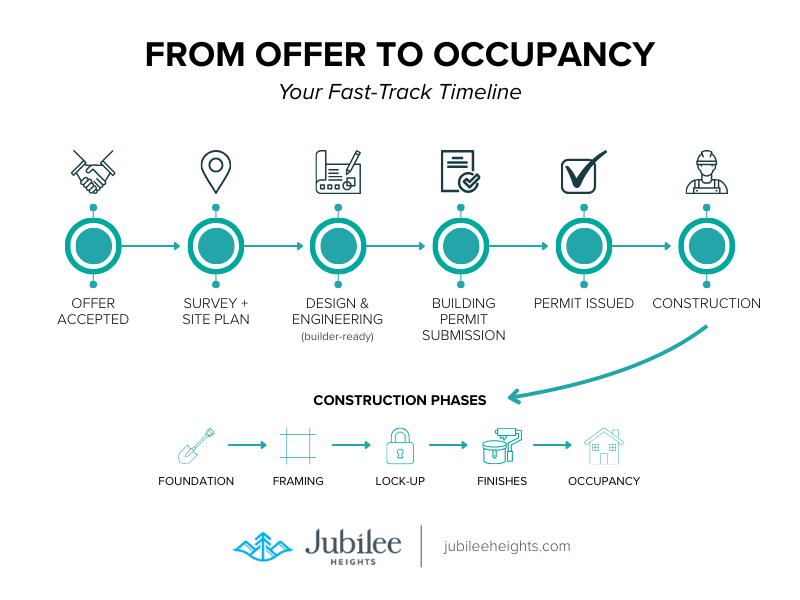
The three most common causes of timeline overrun on Campbell River builds:
- Incomplete permit submissions – missing energy calculations or structural drawings trigger a re-submission cycle that adds 4–8 weeks
- Plan changes after permit submission – changes affecting structure or servicing require amended applications
- Allowance decisions not made early – trades pause waiting for selections on cabinets, flooring, and fixtures if the timeline isn’t managed
Choosing a Builder: Seven Questions That Reveal What You Need to Know
Campbell River has an active builder market. The questions that separate builders who will keep your project on schedule from those who won’t:
- What is included in site prep, and what triggers extras? Rock removal, over-excavation, and retaining walls are the most common unexpected costs.
- Which energy specifications are standard – heat pump, window performance, insulation R-values?
- How do you handle allowances if material prices change between contract and installation?
- Who coordinates utility hook-ups and the driveway and boulevard standard confirmation with the City?
- What is your draw schedule, and what documentation do you provide at each draw?
- How do you manage substitutions if specified items are back-ordered?
- Can I walk through a completed Jubilee Heights home that reflects my plan and specs?
That last question matters most. A builder who has delivered homes at Jubilee Heights knows the building scheme, the City’s inspectors, and the specific site conditions. That knowledge has real value in the permit and inspection process.
Financing the Build: How Construction Draw Mortgages Work
Almost all Campbell River new builds are financed through a construction draw mortgage. Funds are held by the lender and released in stages after a lender-appointed inspector confirms completion of each milestone. The draws typically align with: foundation, lock-up (framing, roof, windows, and doors complete), and completion. Interest is charged only on funds advanced – you are not paying interest on the full loan from day one.
What makes a serviced lot easier to finance: the lender can verify connection points, road standards, and community infrastructure. The appraisal is straightforward. The contingency requirements are lower than on raw land because the unknowns are fewer. For a Jubilee Heights lot, Couverdon’s sales team can provide the servicing documentation that supports a clean construction mortgage application.
Pre-Offer Checklist for a Jubilee Heights Lot
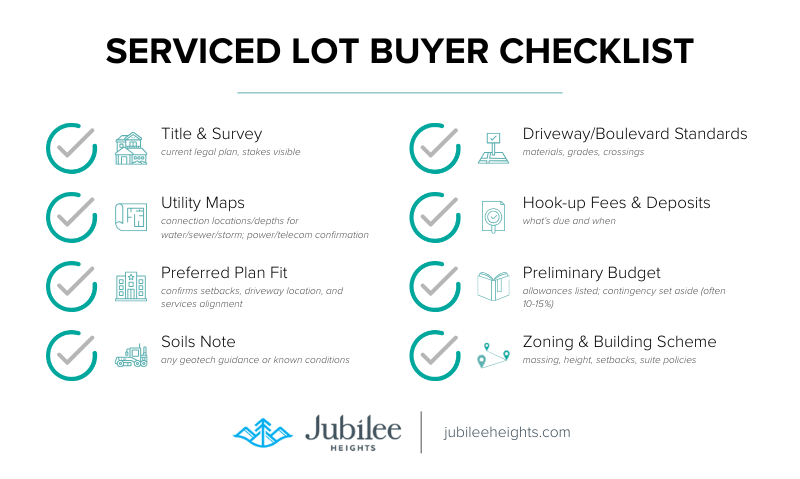
| Item | Why and When |
| Current legal survey – stakes visible on the lot | Before design – confirms boundaries and setbacks |
| Utility connection map – locations and depths for water/sewer/storm | Before design – required for foundation and driveway planning |
| City of Campbell River hook-up fee schedule | Before budget – these are separate from the lot price |
| Building scheme – read in full, not just summarized | Before plan selection – governs materials and massing |
| Zoning confirmation – permitted uses, setbacks, height, suite rules | Before design – confirms what the lot allows |
| Phase 5 or Phase 6 lot plan – position, orientation, frontage | Before design – orientation affects solar, privacy, and layout |
| Preliminary budget – with explicit allowances and 10–15% contingency | Before builder selection – prevents underbudgeting surprises |
Start Here:
→ View available Phase 5 and Phase 6 lots at Jubilee Heights
→ Talk to our sales team about servicing details and builder referrals
→ Read the financing guide for Vancouver Island land purchases
Frequently Asked Questions About Building in Campbell River
How long does it take to build a home in Campbell River on a serviced lot?
From accepted offer to occupancy, most buyers should budget 12 to 18 months for a new single-family home on a serviced lot. That includes 2–3 months for design and engineering, 4–8 weeks for permit review (depending on submission completeness and the City’s current queue), and 8–10 months for construction. Complex plans or high-customisation builds take longer. Simple, plan-based builds can come in at the lower end.
What is included with a serviced lot at Jubilee Heights?
Water, sanitary sewer, stormwater, electricity, and telecom conduit are all at the lot line. Roads are built to City of Campbell River municipal standards with curbs, gutters, and street lighting. Utility connection fees (paid to the City at permit stage) and driveway construction are separate costs.
Can I add a secondary suite to my new home at Jubilee Heights?
Secondary suites are permitted on many Jubilee Heights lots, subject to the specific zone designation, the City of Campbell River’s current suite bylaws, and the building scheme. Suite requirements include minimum floor area, separate entrance, parking provisions, and building code compliance for fire and sound separation. Confirm suite eligibility and parking requirements before finalizing your plan – changes after permit submission are costly.
Do I need a building permit for a deck or garage at Jubilee Heights?
Yes, in most cases. Decks over 600mm above grade require a permit. Detached garages require a permit once they exceed exempt size and setback thresholds. The City of Campbell River’s building department can confirm the specific thresholds for your lot. Confirm before building – unpermitted structures can create problems at sale and are not covered by home warranty.