
Serviced Lots vs Raw Land on Vancouver Island: Which One Fits Your Timeline and Budget?
Predictability and a clear path to move-in versus maximum control and more coordination risk. Here is how to decide.
The choice between a serviced lot and raw land on Vancouver Island looks simple on a listing comparison – the serviced lot is more expensive, the raw land is cheaper. What that comparison misses is everything that happens between offer acceptance and move-in. Timeline, financing access, cost certainty, and the amount of project management required all differ substantially between the two paths. This guide makes that comparison honest.
What ‘Serviced’ Means – Specifically
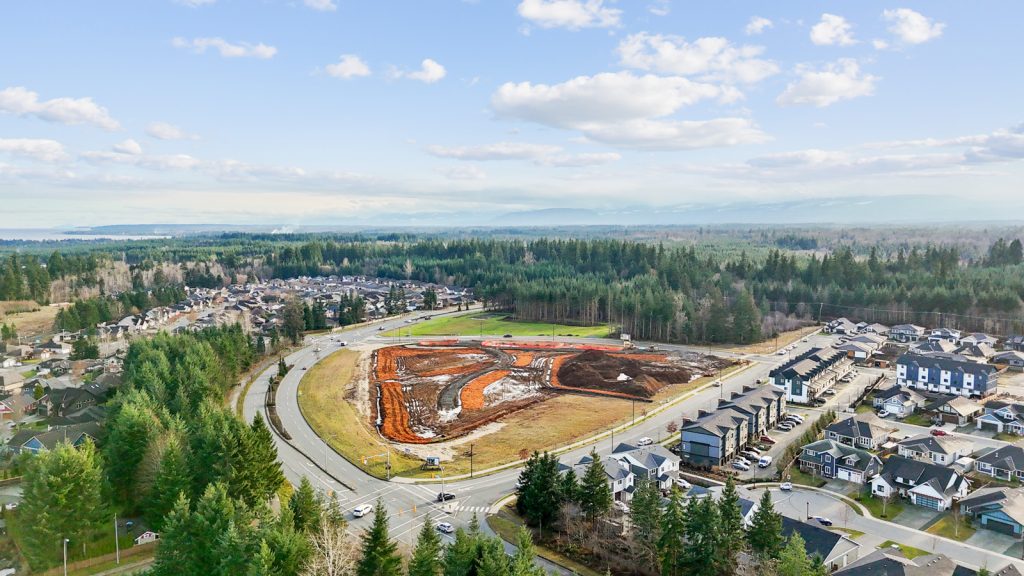
A serviced lot has municipal water, sanitary sewer, stormwater drainage, electricity, and telecom conduit already installed and available at the lot line. Roads are built to municipal standards with curbs, gutters, and street lighting. The utility infrastructure was built by the developer as part of creating the subdivision – and is reflected in the lot price.
At Jubilee Heights in Campbell River, Phase 5 and Phase 6 lots are fully serviced to City of Campbell River standards. Connection points for all utilities are mapped and available before you begin design. The roads are finished. The street lighting is installed.
What this means practically: when your builder starts the permit application, the most common sources of pre-construction delay and cost uncertainty – servicing feasibility, utility extensions, off-site road work – are already resolved.
What ‘Raw Land’ Means – Specifically
Raw land is a parcel without installed services at the lot line. The infrastructure the developer built at Jubilee Heights does not exist here – you are responsible for arranging it. What that involves depends on the specific parcel, but typically includes some combination of:
- Well drilling – locating, drilling, casing, and water quality testing. Yield and quality are unknown until the drill hits the ground.
- Septic system design and installation – requires a Registered On-site Wastewater Practitioner and involves percolation testing and regulatory approval.
- Power line extension – if BC Hydro power does not terminate at the lot boundary, an extension is required at the buyer’s cost.
- Road access – if legal access does not exist via a built road, road construction or an access agreement with a neighbouring owner is required.
- Geotechnical assessment – if there are slope, drainage, or soil concerns that the lender or municipality requires to be addressed before permitting.
None of these items is impossible – experienced builders and rural land buyers deal with them regularly. The issue is that they take time (often 6–18 months before a building permit can be submitted), cost money (often $40,000–$150,000 before a single nail is driven), and introduce uncertainty into both the budget and the timeline.
The Timeline Comparison
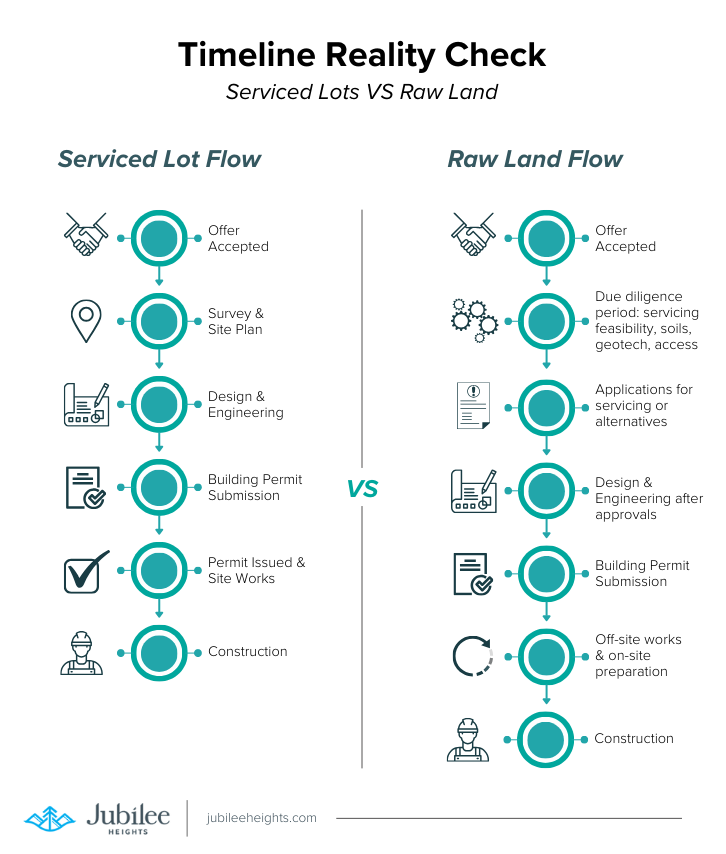
| Stage | Serviced Lot | Raw Land |
| Offer accepted | Week 0 | Week 0 |
| Due diligence period | Title, financing, building scheme – 2–4 weeks | Title, financing, plus: soils, well feasibility, septic, access – 4–12 weeks minimum |
| Pre-construction approvals | Not required – services already installed | Well and septic approval, road access confirmation, possibly geotech – 3–12 months |
| Design and engineering | Can begin immediately after accepted offer | Begins after servicing approvals are confirmed – otherwise design may need to change |
| Building permit submission | ~8–12 weeks after design starts | ~8–12 weeks after design starts (but design starts months later) |
| Permit to construction | 4–8 weeks after complete submission | 4–8 weeks after complete submission |
| Total to shovel-ready | ~4–6 months from accepted offer | ~10–24 months from accepted offer (wide range depending on servicing complexity) |
The Financing Comparison
Lenders have a well-established product for serviced lot construction: the construction draw mortgage. It works because the underlying asset is easy to appraise, the construction risk is contained, and the draw milestones (foundation, lock-up, completion) are predictable. The conversation with a bank or credit union about a Jubilee Heights lot is a familiar one.
Raw land financing is a different conversation. Lenders typically require:
- Larger down payment – often 35% or more for land-only financing
- More documentation – servicing feasibility studies, access confirmation, geotechnical reports if applicable
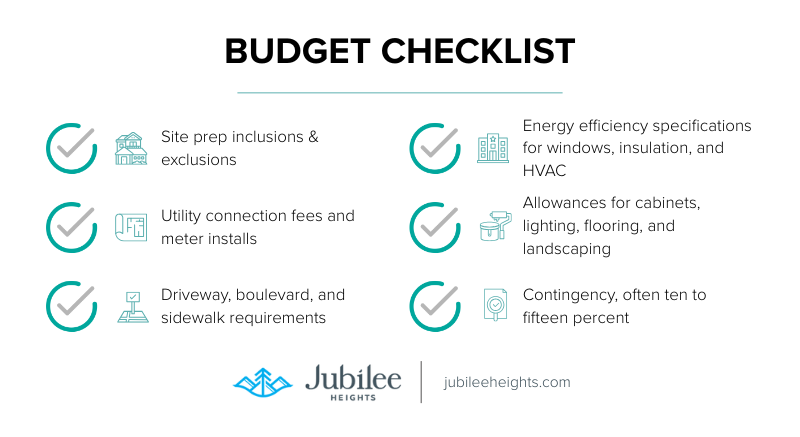
- Higher contingency – lenders want to see 20–30% contingency on raw land builds vs. 10–15% on serviced
- Proof of approvals – some lenders will not advance construction funds until well and septic approvals are in hand
None of this makes raw land unfinanceable – it is financed regularly. It makes the conversation longer, the approval process more documentation-intensive, and the interest costs higher if a land loan bridges the approval period before construction financing begins.
The Cost Comparison – Total Project, Not List Price
| Cost Component | Serviced Lot | Raw Land |
| List price | Higher – developer infrastructure cost is in the price | Lower – no developer infrastructure in the price |
| Well and septic | Not applicable – municipal sewer and water | $25,000–$60,000+ depending on depth and conditions |
| Power extension | Not applicable – to lot line | $0–$50,000+ depending on distance |
| Geotechnical assessment | Not applicable – municipal road complete | $3,000–$8,000 if required by lender or municipality |
| Pre-construction approval timeline cost (land loan carrying) | Not applicable | $15,000–$50,000+ depending on timeline |
| Typical total cost variance | Predictable – site prep, design, build, finishes | Wide – servicing, approvals, access, carry all variable |
On many rural Vancouver Island parcels, a raw land purchase that is $150,000 cheaper than a comparable serviced lot ends up at a similar or higher total project cost once servicing and carry costs are included – and takes 12–18 months longer to deliver occupancy.
When Raw Land Makes Sense
This is not an argument that raw land is always the wrong choice. It is the right choice in specific circumstances:
- You need scale – 5+ acres, agricultural use, forestry, or a use that serviced lot sizes cannot accommodate
- You have specialist knowledge and relationships – experienced owner-builders or developers who have done multiple raw land projects know how to manage the approval process efficiently
- You have a genuinely long horizon – you are not planning to build for 3–5+ years and land appreciation is the primary goal
- You have a specific site requirement – water access, orientation, privacy, or view that serviced lots in master-planned communities cannot deliver
For buyers who want to build their primary home, who have a target move-in date, and who are financing through a conventional lender, a serviced lot at Jubilee Heights is almost always the faster and more cost-predictable path.
See Available Serviced Lots
→ Browse Phase 5 and Phase 6 lots at Jubilee Heights
→ Read the complete building guide for Campbell River
→ Talk to our team about lot selection and build planning
Frequently Asked Questions About Serviced Lots vs Raw Land
What does ‘serviced’ include on a Jubilee Heights lot?
Municipal water, sanitary sewer, stormwater drainage, electricity, and telecom conduit are all installed and available at the lot line. Roads are built to City of Campbell River standards with curbs, gutters, and street lighting. Utility connection fees – paid to the City at permit stage – are separate from the lot price. Our sales team can provide the current fee schedule.
How much longer does a raw land build take compared to a serviced lot?
It depends on the specific parcel and what approvals are required. The pre-construction stage – well and septic approvals, power extension, road access confirmation, any geotechnical work – typically adds 6 to 18 months before a building permit can even be submitted. On a serviced lot, design can begin immediately after accepted offer.
Is it cheaper to buy raw land and add services than to buy a serviced lot?
On headline price, raw land appears cheaper. On total project cost – including well, septic, power extension, road access, geotechnical work if required, and the carrying cost of a land loan during the approval period – the gap typically narrows significantly or disappears. On many Vancouver Island parcels, total costs are comparable, and the raw land path takes 12–18 months longer.
Can I get a construction mortgage on a raw land purchase?
Yes, but it is more complex. Lenders typically require larger down payments, more documentation (servicing feasibility, access confirmation, geotechnical reports), and higher contingency reserves for raw land builds. Some lenders require proof of servicing approvals before advancing construction funds. Serviced lot files are simpler to underwrite.